KILL HIM
by deri••123 views
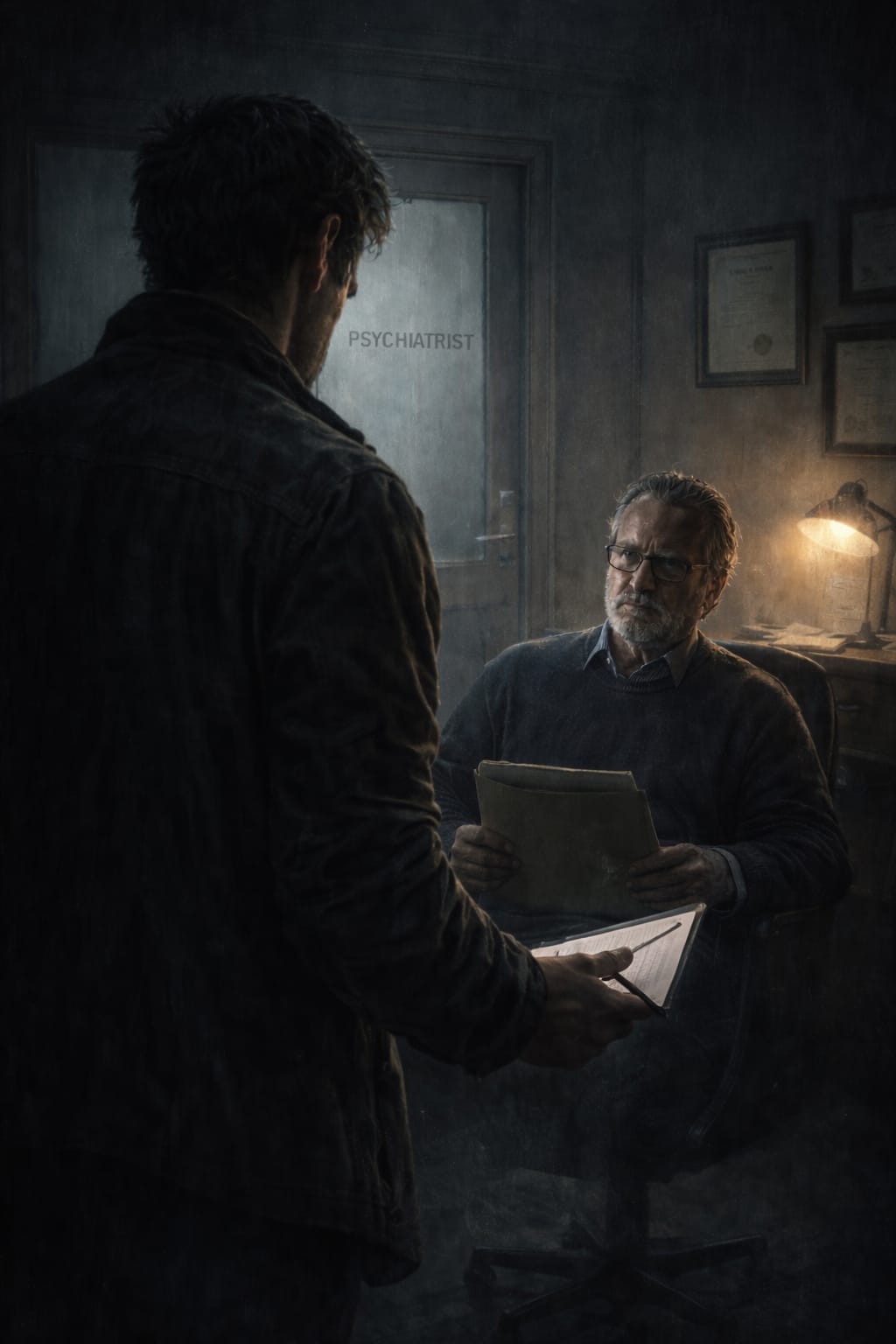
KILL HIM
"Kill him..."
It would have been a magnificent opening line.
It had been almost a year since my last story, and I still could not put down a single sentence. The medication they gave me wouldn’t let my mind settle, and worse, it wouldn’t let me think. I sat at the computer for hours until I felt myself slipping, furious and helpless. The pain of not writing drove me to swallow more pills, feel worse, and lock myself inside a vicious loop. If you want it in one clean sentence: I wanted to die.
I kept typing nonsense and deleting it. Sometimes I nodded off at the keyboard; sometimes my senses dimmed and I just hammered random keys. There was no future left in me. Only the past. No strength to hold on. So I decided to bring my doctor a story I had written before and make him read it. I would prove I was a good writer. He would have to let me stop the medication. And I could write again. That was the beginning.
That day in session, I told him I wanted him to read the story and then spend the whole hour talking about it. He agreed. When he finished, he looked startled, almost spellbound.
"Why did you bring this to me?" he asked.
My answer was simple. "I want to stop the medication."
When he said it was impossible, it was my turn to ask why. I listened to a long lecture of professional nonsense and then asked for one thing: time. Just for a while, I didn’t want to take anything. He resisted at first, then softened. We could try tapering off in a controlled way, he said. There was an alternative treatment. But I would have to see him once a week. For the first time in a long time, I felt hope.
Of course I could have stopped without his permission. I could have quit and never walked through his door again. I had tried that before. It did not end well.
I was eighteen when I was diagnosed. No matter how I fought it, that was the first time I started medication. The moment I realized the pills were harming me instead of helping me, I stopped. Quietly. No one knew. I pretended to take them and threw them away each day. No one noticed. Everything looked fine. Because they believed I was taking my meds, they decided I was healed.
And the absurd thing is: I really was. Without the pills, I could control my mind. I could focus on my studies. I didn’t have a single episode until the day my parents died in a car accident. The police said a brake line had burst; they were going too fast and could not stop.
After that, everything began to tip and spin. In the end my aunt convinced me to go to a clinic. Maybe I’ll tell you what happened there another time. But whatever it was, it taught me to fear one thing above all: stopping medication without a plan.
My doctor adjusted the doses first, then reduced them slowly. Those were not easy days. I withdrew into myself and slept almost twenty hours a day. In the hours that remained I would rage, or cry, or sit perfectly empty. A month passed like that and I was completely off the medication. The sessions, the alternative methods, all of it began to work. We were both relieved.
It took time to start writing again. When I finally did, the first story I wrote was dedicated to the days I could not write.
My doctor decided I was obsessed with death and insisted we go back to medication to work through it. I argued. I asked for more time. He made a bargain: I would bring him new stories. No death. Calmer. Quieter. Maybe even constructive.
The more I wrote, the more I wanted to write. I could barely stop myself. Sometimes I still produced garbage and tore it up, but most days I made something good. I had no intention of returning to the pills. My doctor saw it too. He could read the dark circles under my eyes, the jitter in my behavior, and he would tell me to rest. Yet he kept wanting my work.
He took every story and filed it away. I only wanted to read them to him and leave with them in my bag. He insisted they should stay with him. It started to bother me.
Then he began asking for a story at every session. When I said I hadn’t been writing, he would smile and say, "Then we should go back to medication." I was trapped. Leaving him was no longer an option. He had dozens of my stories, and I knew he had a plan.
He would steal my flawless stories. He would publish them under his own name and, perhaps, become a celebrated writer. Signings. Fairs. Lectures. Universities inviting him to speak. People asking how he wrote so well. And of course he would never say, "I stole them from my patient." He would talk about effort, about suffering, about the long nights.
Before long he confessed it himself.
"I want one last story," he said. "We’ll have our final session. The book I’ve been working on is finished, and I’ll be focusing on that for a while. Don’t worry. I have a colleague who can continue with you."
It felt like a blow to the skull. I didn’t even hear the rest. I remember leaving in a rush, then finding myself on the street, walking with hatred in my mouth like metal. Hatred turned, slowly, into something deeper: revenge.
There is something I haven’t told you. My circle is dirty. Getting poison is child’s play. If I wanted, I could have someone killed without lifting a finger. I even have friends who would do it for me. But that wasn’t what I wanted.
I wanted my hands in it. I wanted to watch revenge happen and feel it, bright and terrible, in my chest. Otherwise I would kill myself. Picture it: the last cigarette, the pack empty. Perfect timing. So, to keep myself alive, I made a perfect plan.
Ricin was harder to find than I expected, but not impossible. I chose the most suitable story for our final meeting. With every precaution taken, I sealed the pages and the powder in an envelope. Inhaled, ricin gives you no more than seventy-two hours. Internal bleeding. Organ failure. Death, inevitable. And it would be.
All that remained was to hand it to him.
At the appointment we chatted for a while. I told him I had brought one last story. So it was true: he was leaving me. "A farewell gift," I said, and placed the envelope in his hands.
"But please," I added, "open it after I’m gone. I want you alone when you read it. Alone so you can give it your full attention. So you won’t be distracted."
He was delighted. He thanked me. Then, as if it were nothing, he told me I needed to start the medication again. Of course. He was done with me. He advised me to take a break from writing, to rest my mind. He wrote a prescription and pressed it into my hand.
I stood up. He shook my hand warmly. I shook his back, smiling, while cursing him in my head.
Just as I reached the door, he called out. "I almost forgot. This is for you."
He handed me a box wrapped like a gift. I took it, stiff with politeness, and opened it. A book. His face on the cover. His book.
"New Methods in Psychoanalytic Analysis." So that was the book he’d mentioned. A pile of scientific nonsense.
For a moment I stared at the envelope on his desk, still unopened, as if time had stopped around it. Then I walked out.
I went down to the sea and sat for a while. I drank tea and ate a simit. I folded the prescription into a paper airplane and threw it into the water. I’ll admit it: the brake line wasn’t a bad idea, but it was a cliché. Ricin, on the other hand, was genius.
What a perfect ending.
"Kill him..."
- deri