THE LAST PERFORMANCE
by deri••352 views
THE LAST PERFORMANCE
“Dreaming,” he thought, drifting back from his distant reverie. “Is there an age for dreaming? When you’re twenty and at the very beginning of the road, or when you’re older with pockets full of money… do we all dream the same way? Do we all have the same right to lean our lives on a dream?” A faint, cracked smile appeared and vanished.
At that moment, the stagehand barged in without knocking, the manager’s favorite yes-man.
Adnan had finished getting ready backstage, his puppets lined up in careful order. He shifted on his stool as the boy entered. The kid was young. His freckled face, the nose that looked as if it had been glued on later, made him even harder to like. When he smiled, his mouth stretched into something lifeless. He rolled his eyes at Adnan for a long second and said, “The hall’s empty. The Manager wants you.” He sounded almost pleased. Adnan, on the other hand, felt the color drain from his face.
The manager’s office smelled sharp and heavy. It made Adnan’s head swim. Then he saw the man in the oversized leather chair, belly pushed forward, wearing that vulgar grin, and Adnan’s stomach turned. Disgust rose and filled him.
“Come in. Sit down, Mr. Adnan,” the manager said, casual. The “Mr.” came out as if it cost him. His eyes were already bored, already looking past Adnan. He wanted this over quickly.
He leaned his elbows on the desk and stared around the room, careful not to meet Adnan’s gaze.
“Look, Mr. Adnan, we go back. You know me. I value art. But everything has a price tag, doesn’t it? If this place doesn’t make money, how do you think it keeps running?”
He looked as if waiting for Adnan to nod. When he didn’t, the manager continued.
“You’re old-school. You know your craft, you’re an honest man. I won’t play word games. Your shows haven’t sold tickets for weeks. Kids don’t care about puppets anymore. They’re into tablets, phones. What are they supposed to do with your worn-out puppets, right?”
The manager grinned, as if he’d made a joke. In Adnan’s mind, only one sentence kept repeating: Kids don’t care about puppets anymore.
“What are you saying, sir?”
“No point dressing it up. It’s not working.”
“So that’s it,” Adnan said. “It’s over.”
“Let’s not say ‘over.’ Let’s say you’re not bringing in money.”
“But…”
“No buts. One month, I’m giving you one month. We pay you while the hall stays empty. Where do you think that money comes from? No one asks what I deal with here. No one thinks about me. It’s always me, me, me. What a country.”
“That’s not what I meant,” Adnan said. “I just…”
“Just what, Mr. Adnan? Just what? Don’t worry, I’ll settle what I owe you,” the manager said, waving a hand as if brushing off dust.
Adnan left the office like a man walking out of a wreck. Head down, fingers worrying each other, feet dragging, the weight of the whole world on his back. It was time to gather what he had made with his own hands, what he had given his life to, what he had loved like family. The road was calling.
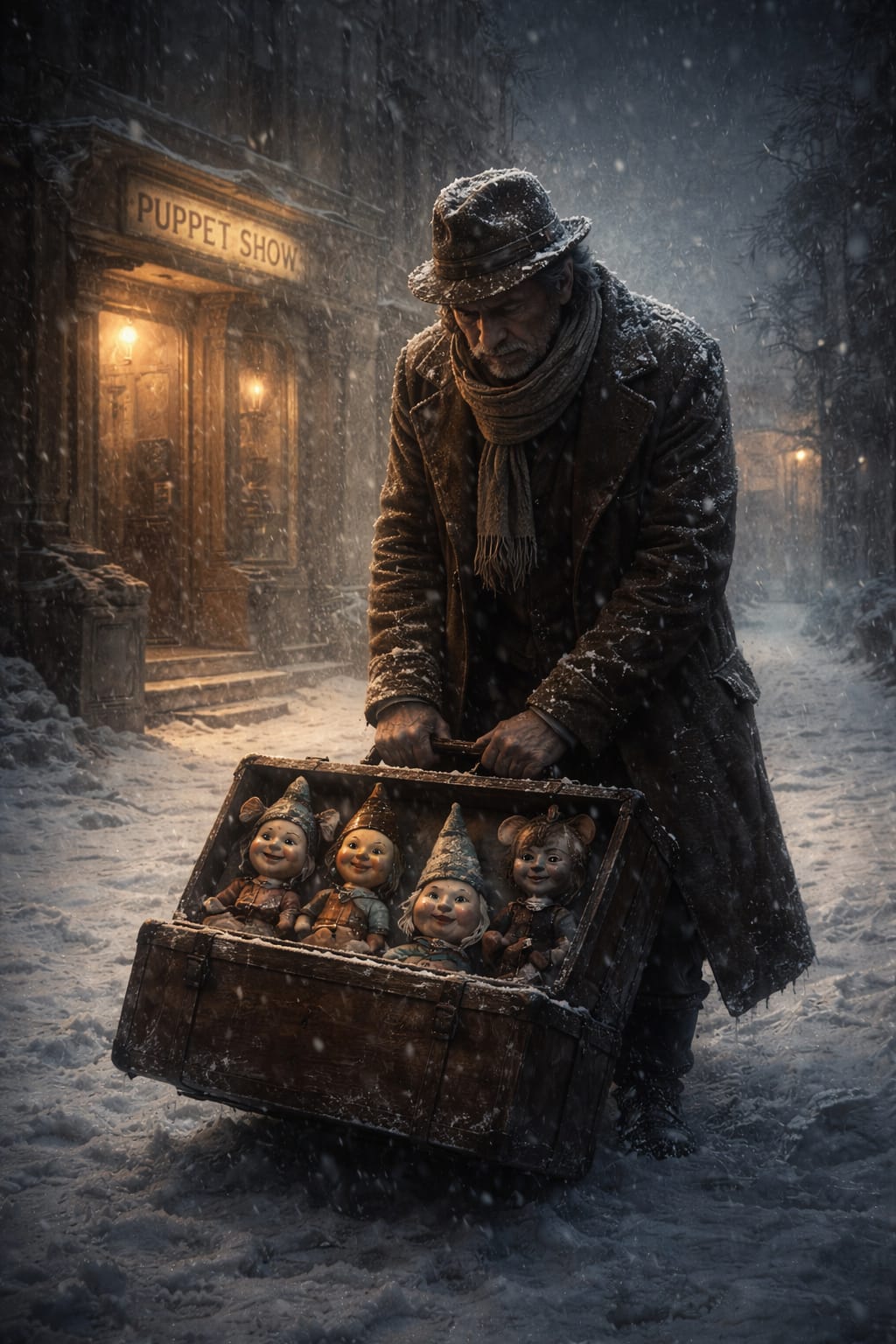
He stuffed his puppets into an old, torn suitcase. He looked at his stage one last time, then walked out of the building.
The manager stood at the window watching him go, muttering to himself. “I did what had to be done. You can’t run a place like this without money, Mr. Adnan. The boss asks me for accounts. People don’t like simple things anymore. Kids don’t want your cheap puppets. How long could I have carried you? I couldn’t. Could I? Maybe. Who cares.”
By then, Adnan was already gone.
He had met puppets when he was very young. In third grade his father had pulled him from school and taken him to a small workshop near their home in Bursa, where a master made Hacivat and Karagöz figures. He’d been furious with his father back then. Four years later his father died, and caring for his mother fell on Adnan’s shoulders. He learned the pride of earning bread and clung to the craft until it became his devotion. Two years after that, his mother died too. He filled his loneliness with puppets, calling them companions, spouse, children. Laughter and applause had been enough.
The past stung his nose. “Still,” he whispered, wiping his eyes, “those were beautiful days.”
Now he was angry, maybe not at the manager, but at being forgotten. Hurt to the core, he talked to himself like a stubborn child.
“I won’t perform again. I swear it. I’d rather die than take the control stick in my hand. Why should I? I won’t. I won’t.”
In his palm he clenched the few coins he had left, as if squeezing them could change the day. He walked toward home, then slowed, then stopped at a fork in the road.
Home? First the landlord, to beg for time. But the cupboard was empty. Bread first. Pasta.
They don’t like puppets… Puppet-making takes patience, it takes craft. Not just anyone can do it. If it isn’t real, it’s nothing.
He turned to the little grocery, bought what barely filled a small bag, and then, hating every step, went to see his landlord.
He was ashamed and exhausted. He forced the words out with a trembling voice. “Peace be upon you, Mr. Rüstem. If you have a moment… could we talk?”
Rüstem was rich, not from his father but from himself. He owned houses and shops in the passage, all rented out, yet he was never satisfied. A miser with a hungry eye. He spoke quickly, always in a hurry, always looking down at people. When he saw Adnan, he pounced on the chance to show off.
“Ooo, Adnan! Look at you. Did you catch the smell of the food? Come, come. Pull up a chair, fill your belly.”
The tone scraped Adnan’s nerves, but he wanted this over.
“No, thank you. Enjoy… I came about the rent.”
“Hm. Go on.”
“I know I’m behind,” Adnan said. “But I need a little time. I was let go today. Just until I find work. I swear I’ll pay. The moment I do.”
Rüstem’s face hardened and darkened. When money was involved, nothing else existed.
“What are you saying? Is this a joke?” he shouted. “Nobody gives me anything for free, so why should I give you anything? This is a house! I don’t care if you got fired. Am I your father? Your brother? Vacate my place. Get out! And bring my money as soon as possible. I swear I’ll go to the police, I’ll drag you through the courts!”
Adnan felt his legs turn to water. A hand seemed to close around his throat. Cold sweat broke on his skin. He put the last of his money on the table and walked away without a word, because he couldn’t find one.
He had never wanted to die more than he did then. If death weren’t a sin, he would have ended it right there. But he couldn’t.
So he went home. He packed two suits, a few clothes, the tools and materials of his trade, and left quietly. Then he walked, stubbornly, into the unknown until night came.
He didn’t know how far he went. The sky had long turned black, the streets had thinned to a few late shadows. In the mild breeze, among the scent of fresh blossoms, he finally collapsed at the edge of the pavement.
And then, for the first time that day, kindness reached him.
“Uncle! Are you okay, uncle? Someone run and bring water!”
A young man sprang from the coffeehouse across the street, dark-haired, handsome enough, moving fast as if summoned.
“Uncle! Hey, are you dead? Come on, help me here! Did he hit his head when he fell? Did anyone see?”
Adnan opened his eyes slowly and stared up at him.
“I’m fine,” he said. “Just… my vision went dark. Help me up. I’ll go.”
“Are you sure, uncle? Should we go to the hospital?”
“No. Bless you. I’ll go. Thank you.”
“If you say so, but it’d be better if you sat a bit. Come, have a hot tea with us.”
Adnan tried to stand, to leave, but the young man had already noticed his directionless steps. He picked up the suitcases and started toward the coffeehouse as if the choice had been made for both of them.
Under the boy’s stubborn questions, Adnan’s strength ran out. He told everything, crying as he spoke. The tea glass trembled in his hand. He looked fragile and gentle, and heartbreakingly dignified, even in ruin.
The young man listened, thinking. Then his eyes lit up.
“My uncle,” he said, “listen. I don’t know if you’ll accept, but there’s an empty house. My uncle’s place. It’s a little shack, but it’s clean. They went to France, the whole family. Workers, you know. The key’s with me. Don’t worry about rent. Let’s get you settled. The rest, we’ll figure out.”
Adnan was moved and humiliated all at once: moved by the kindness, humiliated that a master puppeteer had fallen so low. He covered his face with his hands and sobbed. The young man talked and soothed until, at last, Adnan agreed.
They walked through small, modest streets, the young man in front, Adnan behind, until they reached the house. It wasn’t in bad shape. Compared to the streets around it, it was a palace. A small yard, barren but real. Two rooms, a kitchen, a bathroom that shared space with the toilet. One room had a bed. In the other, a sofa, a table, chairs. A few pots and pans in the kitchen. Enough.
Adnan thanked him, awkward with gratitude.
“I’ll come by,” the young man said. “If you need anything, tell me. Now sleep.” He hugged Adnan hard, then left.
Adnan didn’t sleep. He didn’t even take off his suit. He sat on the edge of the bed, as if it didn’t belong to him, and waited for morning.
He had only just drifted off when the first light woke him. Outside, women walked with their market carts. He stepped into the yard, eyes swollen from crying, and realized they were heading to the neighborhood market. It wasn’t far.
The market was an opening.
“So what if I don’t perform?” he thought. “I can make small puppets and sell them.”
Selling puppets felt like selling his children. But he had no other idea. It was bread, after all. And he hadn’t sworn not to make them. He had sworn not to perform.
Summer came. Adnan made puppets and sold them, earning enough to survive. He even insisted on paying rent, eventually convincing the young man to accept. The neighborhood grew used to him, then fond of him. In the warm weather he worked in the yard, sitting on a rug, sometimes reading the newspaper, rolling tobacco, trying to be happy in the only place that still held him up.
Around then he noticed the window across the way.
Every time he looked, the curtain stirred and a small shadow moved behind it, pacing. Days later, the shadow became a pair of large, brown eyes staring at him. The most attentive eyes he had ever seen. The furtive, frightened hiding was gone; now the gaze was locked on him.
Whenever Adnan stepped into the yard and picked up his chisel, the eyes appeared. The child would rock back and forth and stare at Adnan’s hands without blinking, never meeting his eyes. Adnan waved, once or twice, beckoned gently. Each time, the child fled.
All he knew was this: there was a strange thread between them, and on both ends of it, curiosity tugged hard.
On one of the young man’s visits, Adnan finally asked, “Who is that child?”
“Burak?” the young man said. “Burak’s dear, but… he’s a little different.”
“Different how?”
“There’s something in his mind, uncle. Not crazy. Sharp, actually. But strange habits. Two years ago, he ran away. The whole neighborhood searched. His mother was terrified. We found him down by the TV shop, crouched in front of the display window, knees to his chest, rocking while he watched. When his mother grabbed his arm, he screamed like a train horn. Hit his head, cried, jumped. We got scared. After that, none of us could go near him. His poor mother dragged him home without a word. Later his father said he tried again once or twice. His mother frightened him, told him all kinds of lies so he wouldn’t run. Since then he can’t go out. No school, nothing.”
“What lies?” Adnan asked.
The young man shrugged. “That people would kidnap him, cut him up, make him beg. That if he went near anyone, they’d kill him.”
Adnan’s chest tightened. Poor child, he thought. What beautiful eyes.
For days he tried to imagine a way to reach Burak. The boy’s delicate face, his light-brown hair, his sun-starved pale skin… it tugged at Adnan like an old longing. He had always wanted a son. Seeing Burak, he felt it again, painfully tender.
Children usually liked Adnan. Maybe words would help. But the parents were afraid. And Burak, even when he watched, never once looked into Adnan’s eyes. Adnan was old enough to be his grandfather. Still, he wished they could be friends.
A whole season passed. Autumn came. Adnan stopped going out much. The damp in the house and the cold in the air weakened him; he grew sick. He didn’t have the strength for the market. Yet his mind stayed with Burak.
Across the street, days turned into a private nightmare.
Burak became more withdrawn, more miserable, more irritable. Nothing his parents did could calm him. He had bitten his nails down to nothing, and now he tore at his fingers until they bled. Most nights he cried until dawn, then slept only from exhaustion.
When his father left at first light to collect scrap, the mother faced the hardest hours alone.
Burak ran to the window again and again, opening the curtain, closing it, opening it, closing it, for hours. Then he would rush to the door, sit on the floor, and rock while he cried, sometimes falling asleep right there. Those moments frightened his mother most.
What if he leaves again? What if we can’t find him? What if something happens?
She tried to pull him away from the door. “If you step outside,” she would say, “they’ll kill you.”
That was what truly broke him. The boy spoke little as it was; now he sank even deeper, and his pain lived only in his eyes. His parents didn’t understand him.
And winter… winter was the mother’s great dread. Whenever snow fell, Burak spiraled. He would stand for hours staring at the snowfall, refusing food and water, slipping out of reach of everything.
Winter was coming to the shanty streets. And Burak was already drowning.
After a stretch of fevered days, Adnan made his decision.
He chose his finest piece of wood. He took his chisel, mallet, and brush and began to carve, slowly, reverently, as if the act itself could be a prayer.
As the cold deepened, his fingers cracked. His hands split open. Sometimes they bled badly. He didn’t care. He had to make the most beautiful puppet of his life.
He carved the nose, the mouth, the eyes. Smoothed everything with sandpaper. Cleaned it with the brush. Each step felt like a sacred rite. He painted the face delicately, varnished it, built the hands and arms.
He was close now.
If he died, he thought, at least something would remain. A masterpiece, meant for the one who deserved it.
Winter came early. Adnan’s hands could no longer endure the cold. Even with the puppet almost finished, he had to stop again and again, pain forcing breaks.
He missed Burak more each day. He no longer even saw him at the window. Sometimes he heard screams from that house and felt sorrow soak into him like damp.
One night, Burak’s voice snapped him awake.
A single word rang out into the empty street.
“Grandpa!”
Adnan knew it was for him. He wanted to run, to cry, to answer, I’m here. But he feared what the family might do, what the fear might turn into.
There was only one thing he could do.
Finish it.
He worked all night, ignoring his bleeding fingers. By morning, as the sun rose pale and cold, the marionette was finally done. Even Adnan stared at it in awe.
Only then did he think to look outside.
Everything was white. The shanties, the street, the yard. Snow covered the world like a hush.
Adnan set his stool in the middle of the yard. When he lifted his head, he met Burak’s gaze.
Tears ran down Adnan’s cheeks. In Burak’s eyes, something bright flared, as if light itself had found a home. For a brief moment they held each other there.
Burak pressed his forehead to the window, hungry with wonder. Adnan sat down. Slowly he brought the puppet from behind his back and took a deep breath.
He had sworn not to perform again.
And yet, with a strange, fierce joy, he slid the control stick between his fingers.
So softly only he could hear, he whispered, “For you, my heart. For you. One last performance.”
Burak’s mouth fell open. His eyes grew huge. If the whole world had gone silent, you could have heard both their hearts beating.
On the white stage of snow, there was only Adnan, the puppet, and a pair of brown eyes. Everything else seemed to stop.
Snow fell in thick flakes. Neither of them noticed.
Adnan looked up again, hoping for one more second of eye contact. Burak yanked the curtain closed and vanished.
Adnan waited, frozen by disappointment, until the wooden door across the yard creaked open.
Burak stood there.
He was just over a meter tall, thin as a reed, face pale. He wore pajamas and a light knitted cardigan. Nothing else. Bare feet on the threshold. For a moment he only looked at Adnan.
Adnan, a smile he couldn’t control pulling at the corner of his mouth, kept the puppet dancing.
Burak’s first bare step onto the snow made a small crunch. The cold made him shiver. One step, then another, timid, stiff, frightened. He came close, stopping within arm’s reach of the performance. He clasped his hands in front of him, eyes fixed on the puppet as if nothing else existed.
Silently he watched his private show.
One played. One watched. Peace settled on them like a blanket.
Then Burak took one last step, sure this time.
Under Adnan’s astonished gaze, the boy reached out with thin fingers and took the puppet. His hand found the control stick. He slid his fingers into place. Awkward at first, clumsy, but… as he moved it, it was as if he stepped into another world. Calm. Steady. Whole.
Adnan looked up and saw doors opening one after another.
Wooden doors, creaking in the snow.
Children came out of their houses. They watched from a distance. They smiled.
Adnan’s last performance had become Burak’s first.
The manager had been wrong. The landlord too.
In a forgotten shanty neighborhood, there were still children like this, still people who didn’t think like the rest, who didn’t live by the same rules. And somewhere among them, in the hush of snow and the small movement of a puppet, hope was waiting.
deri