The Slope of Zevahir
by deri••306 views
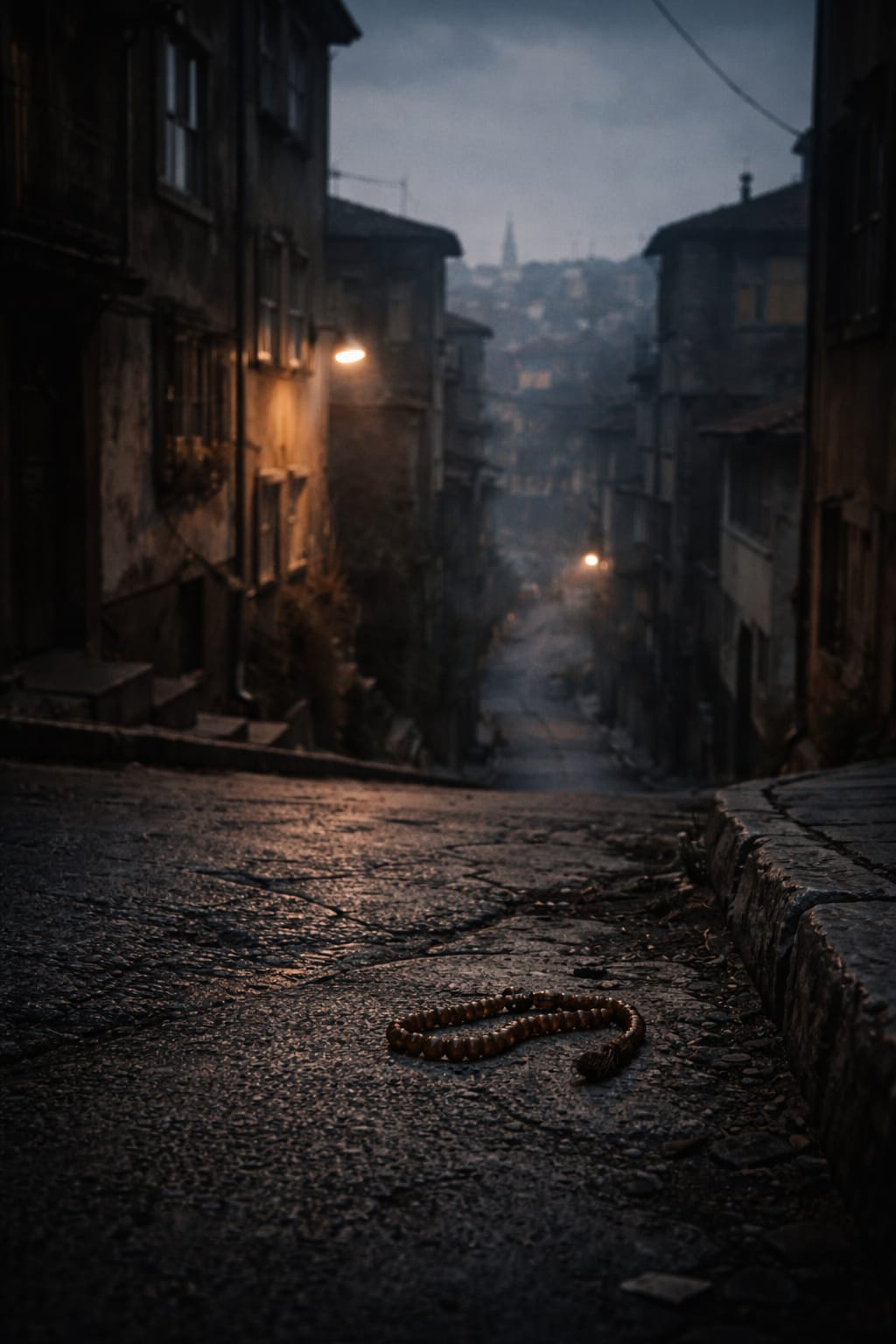
The Slope of Zevahir
This place used to be a field. Now it’s a five-story building. They turned the shop on the ground floor into a coffeehouse. Whenever I come back to the neighborhood, I sit here and drink a tea. It always tastes stale, bitter, burnt at the edges, but it’s become my little ritual. I watch the street like it’s a slow film, skim the front pages of whatever newspapers are lying around, and put off going home for as long as I can. Because every time I stand at the top of that slope, Hüseyin rises in my mind, along with that late afternoon.
I’m a teacher’s child. Some people think that’s something to be proud of, something polished and respectable. In our house, nothing was ever ordinary. I was the loneliest kid in every school we passed through.
I remember my mother at the kitchen table as if it were yesterday, arms folded, staring at my father with empty eyes. He sat across from her, talking about the principal, about “the investigation,” about what had been said behind his back. My mother listened the way people listen to rain, present but far away.
“Don’t sulk, woman,” my father said.
Whenever he tried to soften her, he slipped into the Niğde accent, rolling his words into a kind of joke. Most of the time it worked. This time, my mother wasn’t angry. She was sad. The light had drained from her face. She looked at him as if she were waiting for the real sentence to arrive. My father kept going.
“All right, all right. You know I wasn’t guilty in that investigation. It was the principal, sticking his nose where it didn’t belong.”
“So you just sat there quietly, and the principal decided to slander you, is that it?”
“Did I commit a crime to be slandered? Books, poetry, theater, are those crimes? Trying to widen children’s horizons, stepping a little outside this memorization-obsessed system that turns their minds dull, is that a crime? They want us to teach only what they approve. They tell us ‘be silent,’ and we’re supposed to shut our mouths. Talk about kings and sultans, but never mention the people crushed under them. Teach the discovery of the Americas, but don’t say a word about what was done to the people already living there. Explain earthquake types, but skip the buildings that collapse because of corrupt contractors. Teach basic arithmetic, but don’t speak of poverty. Sure. For heaven’s sake, don’t you start saying this too.”
My mother shrugged. My father stood slowly, straightened his chair, and walked to the door. He paused with his hand on the frame and spoke over his shoulder without looking at her.
“We’re moving to another city.”
“Call it exile, then. I’m not coming. I swear I’m not coming with you again. Adil. Listen, Adil, this is the last time. Thank your luck the child is still little. Otherwise I wouldn’t stay one more minute. I’d divorce you.”
My father left without another word. He came back after I’d fallen asleep. Years have passed, cities have changed, but whenever I return to that scene, something in my nose stings, as if grief has a smell. I will never forget my mother’s sorrow or my father’s wounded pride.
Not long after, we moved here. To Zevahir Slope.
Zevahir is a neighborhood built along a narrow, brutal incline, lined with buildings that never rise above three stories. Twenty on one side, twenty on the other, all old, most unplastered, unpainted, neglected. Women hang laundry from balconies. The street smells of cooking, and most of all of onions.
My school, my friends, my street, everything I loved and everything I hated, stayed behind. They enrolled me at my father’s school right away, a small neighborhood primary school a little further down the slope. Neighborhood schools are all alike, and so are the children. Their uniforms are either too small, handed down from older siblings, or too big so they can grow into them. Boys with hair cut close, girls with braids, all of them carrying the same mix of soap and dust. They dream similar dreams and, most evenings, eat the same dinners at home.
And then there was him.
The man at the top of the slope.
Hüseyin. Lame Hüseyin.
I never knew when Hüseyin came, when he went home, when he ate, when he slept. He was there in the morning and there at night, at every hour, as if he’d been hammered into the street itself. He never spoke to anyone. I was terrified of him. It seemed like, if he stretched his arm, he could touch the second floor of a building. Like he could lift a car by himself and carry it somewhere just to prove he could. In his stare there was not even the smallest trace of mercy. I was convinced he was a monster.
When I told my father, he scolded me. “I’ve noticed him too,” he said. “This neighborhood is full of tough men. Still, thinking like that doesn’t suit us, Ulaş. We should see if we can win him over.”
My father was always like that. He believed people could be reached. He would fight for it, and in the end he would lose, and he would still believe it. Hüseyin was the neighborhood thug, prayer beads in hand, posted at the top of the street all day, looking first toward the school, then toward the other end, as if his gaze itself could keep the world in line.
After that, my father asked around. People only knew his name. He lived with his mother. No one had ever seen him chatting with anyone. They’d been here for years, but mother and son were closed to the world.
One morning, as we passed, my father greeted him. We were on our way to school. Hüseyin was at the top of the street as always.
“Good morning,” my father said.
I clamped down on his hand and tucked myself under his coat. Hüseyin didn’t answer. He only rolled his eyes and looked away.
Good, I thought. Now my father will give up. But my father’s face held that gentle, stubborn smile. A few days later I understood why.
We were walking home from school. My father slowed his steps, then, as we neared Hüseyin, straightened his back as if he were stepping into a classroom. He stopped directly in front of him. Next to my father, Hüseyin looked like a wall.
My father reached into his jacket and drew out a book.
“Here, son,” he said, holding it out. “I don’t know if you like reading, but this is one of my favorites. I thought you might. My name is Adil. I teach at the school down the hill. We just moved here, though I’m sure you’ve noticed. If you enjoy it, I can bring you more. I have plenty of books.”
I stood frozen. Hüseyin’s face didn’t shift. No thank-you, no insult, no reaction at all. My father patted my head and went on as if he were talking to a neighbor he’d known for years.
“And this is Ulaş, my son. He’s in primary school. All right then. Take care. We’ll see you around.”
I was furious. How could he say my name? How could he act so warmly toward someone who wouldn’t even speak back? If my mother knew, she would explode. She had agreed to move with my father one last time. If he got into trouble again, she’d leave. I didn’t want that, so I stayed quiet. Maybe I also didn’t want my father to feel alone in his stubbornness.
A few days passed. My father was restless at school, more than I’d ever seen him. Children can be cruel; they sentence people quickly, without needing a judge. I heard them talking. Their parents had complained about my father. Some cursed. Some threatened. This city was different. Even I could see it.
One afternoon, on the way home, a man dressed in black approached us. My father pushed me slightly behind him and stood perfectly still.
“Teacher,” the man said, “you don’t know these parts. Don’t go looking for trouble. You’ve got a kid. If I were you, I’d pack up and leave. If you’ve got any sense, you’ll go.”
My father asked calmly, “Or else?”
“You’ll see, teacher. I’m warning you. Do what you want.”
The man bumped my father’s shoulder as he passed and kept walking.
I was shaking. My father said nothing. He took my hand and started forward. He sighed, deep and heavy. He was trying to look brave, but he didn’t realize he was speaking out loud.
“What am I supposed to do now? Pack up and leave? She won’t come this time, she swore she wouldn’t. What am I supposed to do? Stand in front of them and say, do whatever you want, just get it over with? No. Ulaş is with me.”
Then he lifted his eyes to the slope as if he’d spotted a door in a wall.
“Hüseyin! Lame Hüseyin! I know this started with you. I only gave you a book, damn it. So you’d read. So you’d become a man. Hüseyin… Books shouldn’t kill people. People shouldn’t die because of books. Children should read. Everyone should know the truth. And she swore she won’t come.”
We were almost home when he pulled himself together. Even the slope couldn’t steal his breath that day. At dinner we spoke little. Then I went to bed.
I had never struggled so hard to fall asleep. I dreamed nightmares until morning, waking drenched in sweat. When I finally got up, the ashtray was full to the rim and my father was in the kitchen.
The days that followed were all the same: little talk, little food, little sleep. Hüseyin remained where he always was, at the top of the slope. The moment he saw us from afar, he locked his eyes on us and didn’t look away until we disappeared through our door. My father squeezed my hand harder and took longer strides. I kept glancing back, and each time I saw Hüseyin’s brows drawn together, the way he tightened his grip on his beads, the way his attention sharpened on us, I snapped my eyes forward again.
My mother knew nothing. My father and I carried it between us like a stone, two silent accomplices under the weight of an unnamed fear.
We didn’t have to wait long. That dark night, it happened.
When my father said he had work at school and would be late, I refused to go home alone. I told him I’d wait with him. By the time we left the school, it was fully dark. The streets had emptied.
As we approached the slope, three large men appeared coming toward us, black coats thrown over their shoulders, hands clasped behind their backs, grinning as they walked. My father hesitated, caught between stopping and pushing through. I clung to his arm so hard my fingers hurt. My heart was pounding.
They came right up to us and stopped.
The biggest one spoke, his voice thick.
“We warned you, teacher. You didn’t listen. You didn’t leave.”
My father tried to keep his calm.
“Boys, there’s no need for this. I’m a teacher. I’m nobody’s servant. And what have I done that I should abandon my home? If I left every time men like you told me to, I’d never live anywhere. Who do you think you are? Go on, move along.”
Move along. That, I think, lit their fuse. I heard curses. Someone spat out the word school. There was shoving. Shouting. A roar rising in the dark. One of them pulled something metallic from his belt, a flash of cold light, and lifted his arm toward my father.
There was so much noise I couldn’t even hear my own scream.
I remember crouching, closing my eyes, folding myself into the ground.
I don’t know how long I stayed there. Then a cold hand, shaking, touched my shoulder.
I opened my eyes. It was my father. The street was suddenly empty. No men, no footsteps, no voices. Only my father standing frozen, eyes blown wide, tears on his cheeks, staring at the ground.
I looked too.
A man lay there, drowned in blood.
In his hand, slick with red, the prayer beads.
And I knew him.
Hüseyin.
The neighborhood turned into a battlefield within minutes: police, ambulances, people running, screams cutting through the air. I went to the corner where Hüseyin always stood, sat down, and watched it all from there. From Hüseyin’s place, I watched Hüseyin.
At one point I turned and saw a woman walking toward us on trembling legs, hands folded over her stomach, rubbing her palms together as if trying to warm them. She didn’t enter the crowd. She watched from a distance and cried. A few people went to her. Someone took her arm. Zevahir Slope looked like hell.
Later they caught the men. They were the father of one of my father’s students and his friends. In their statements they said book, they said theater, they said my father wanted to make the children perform a play. Hüseyin had intervened. The knife had found him. They claimed he had nothing to do with it. Their target, they admitted, had been my father.
Hüseyin spent twenty-five days in intensive care.
For twenty-five days my father didn’t speak.
For twenty-five days my mother emptied ashtrays.
For twenty-five days the top of the slope stayed empty.
On the twenty-sixth day, news of Hüseyin’s death arrived at our door, along with his mother.
Her head was bowed. Her hands trembled. Dark bruises sat beneath her eyes. My mother let her in without a word. She motioned for me to go to my room, but the woman said, “If it’s no trouble, let him stay.” I stayed.
A long silence. Then she began.
“We were in Ankara, in Balgat, living in a shack,” she said. “Rasih, his father, named Hüseyin. A year before Hüseyin was born, they shot someone Rasih knew, someone he loved. He said, ‘Let my son carry his name.’ And so he did.
“Hüseyin was six. I will never forget that day. Rasih took him to the coffeehouse. It was 1978, hot weather. I told him, don’t take the child. But he said, ‘This isn’t that kind of place, let him come,’ and they went. How could the man have known they would spray the café with bullets that night? How could he have known one bullet would take his life and another would cripple our boy?
“And how could I have known? If I had known, I would have become a wall, I wouldn’t have let either of them step out.
“Within the year I took my son and ran here. Poor child. His father died in front of his eyes, and he was left lame. He never recovered. At first he would stand at the corner and look toward the school. He wouldn’t go near the other children. He didn’t go to school, my poor boy. He was thin, fragile. Then he grew up. He filled out. And he stuck to that corner.
“The coffeehouse they were shot in was at the top of a slope in Balgat. Deep down I always knew he was waiting for the killers’ road. He replaced the slope in Balgat with Zevahir. He looked at the school and ached. He looked at the road and, in his own way, guarded this neighborhood.”
She cried. We cried with her.
Then she straightened, reached into her vest pocket, and drew out the prayer beads I knew by heart. She stared at them for a long time and sighed. Then she got up, knelt in front of me, set one hand on my knee, and placed the beads in my palm.
“These were Rasih’s father’s,” she said. “Then Rasih’s. When Rasih died, this is all Hüseyin had left. Before he died, he sent them to you, and he said: ‘Children need their fathers, and fathers need their children. I saved his father. He won’t grow up fatherless like me, Mother.’”
She had come for me.
Hüseyin had sent her.
To look at me one last time. To help me grow.
After that day, it was hard to pull ourselves back together. My father and I went to school, came home, seasons turned, years passed. Whenever we reached the top of the slope, my father would nod, so faintly no one could notice it. Only I saw. Only I knew.
My parents never moved away from Zevahir. They even grew to love it. Only I grew up, and left them behind.
Now whenever I return, I sit at this coffeehouse and drink a bitter tea facing the slope. I nod slightly to Hüseyin’s absence.
No one sees.
Only I know.
deri