BIRDS
by deri••318 views
BIRDS
Chapter 1
I used to ask myself how much worse the world could become. Massacres, wars, hunger, murders, and dozens, even hundreds of other wreckages, yet our beautiful home kept holding together.
With those thoughts circling my head, we chose the moment for our major act, aimed at the ones who believed the world belonged only to humans. We would strike all the big companies that experimented on animals, simultaneously, and pray the headlines would finally look their way.
I prepared the Molotovs for our area. Getting sulfuric acid, gasoline, and paraffin was easy enough. Finding that many glass bottles was the hard part. Thankfully, Pigeon Selim saved me.
Pigeon Selim was an older man who lived like a hermit. We called him Pigeon because, as you might guess, he had no one but his pigeons. He even looked like one: a thin neck that seemed ready to snap, a body made of angles and silence. He spoke to almost no one and spent his days with the birds. Now and then he went out for feed or medicine, or a few groceries, and then hurried back home. He only ever greeted me. Even then he wouldn't meet my eyes, just a small nod, head lowered, and he was gone.
That day, when he saw me digging through the trash, he came closer and asked, head down, "What do you need?" Happy that he was speaking to me at all, I blurted, "Glass bottles," without even thinking about our secret. "Come," he said. On his rooftop he handed me two sacks full of beer bottles. No questions, no lecture. He turned his back and left. He didn't even glance over his shoulder as I hauled them away.
A week before the attack, we moved into the homes of friends closest to the target companies. We didn't want traffic, bad luck, or any last minute obstacle. If word leaked, we could meet a police blockade, so we stripped away every risk we could. For a week we watched. Entrances and exits. Who came and went, and when. When the workers arrived, we could not act then, we couldn't hurt a living soul. How many guards, where they stood. Dozens of details, checked and rechecked. In the end we chose the hour: exactly ten. We would hit the front entrance. There were two private security guards, and we planned around them so no one would be harmed. We would carry only what fit in our backpacks and stay invisible until the last second.
Because we kept everything so tight, no one heard about it until it happened, and we met no police interference during the act. We managed, at least, to drag a little attention toward the firms that tortured animals in the name of profit. Several companies took serious financial damage. The police arrived after we were done. We were still chanting in front of the buildings. Of course they detained all of us. On top of that, dozens of cases were filed. Some are still dragging on.
In the days that followed, only a small slice of the public stood with us. Most people didn't care. Worse, some even defended the cruelty. But the deepest wound came from the indifferent, the ones who looked away and kept walking.
We kept fighting, however we could, when something happened that no one could have imagined. Every channel ran the same story without pause. "What's happening?"
The birds. Across the world, all at once, they began to cry out. It wasn't singing so much as screaming. Pet birds, parrots, sparrows, crows, tropical birds, even chickens and penguins. The sound flooded everything. Some people shouted, "Make them stop." Others listened with fear, trying to name the panic in their own bodies.
It sounded like pain. As if someone had hands around their throats, as if they couldn't draw breath. As if wings were being torn, feathers ripped out while they were still alive. The noise was dense and violent, a pressure that made your teeth ache.
It lasted exactly twenty four hours. Then, as if a blade had cut the air, it stopped. Not a single bird sound remained. The world sank into a silence that felt unnatural. Why it began and why it ended made no sense. Stranger still, it started everywhere at the same moment, and ended everywhere at the same moment.
Experts said birds sing for two reasons in normal conditions. The first was simple: mating, or calling their flock closer. The second was darker. "This is mine. I will protect my family, and I'll fight if I have to." But for all birds, across the entire planet, to do the same thing at the same time was impossible. There had to be another cause, unforeseeable and terrifying. We didn't have to wait long to meet the terrifying part. That morning, some people understood the silence before the rest of us: bird watchers, people with cage birds at home, and the ones who went out with simit in hand, ready for the seagulls. Social media asked the same question in a thousand languages, and the wave grew into an avalanche. The birds were gone. Every bird, everywhere, had vanished without leaving a trace. Sparrows, crows, parakeets, none of them. Not even chickens.
Chapter 2
The world turned into a kind of public panic. Reports poured in from everywhere. This wasn't one country, it was all countries, at once. Colombia, the so called bird paradise, announced emergency plans on television, saying they were trying to learn where the birds had gone. Australia, Antarctica, New Zealand, South Africa, South America, and the Galapagos issued statements about penguins. It wasn't only protected species. All birds had disappeared.
No one trusted their government; everyone demanded an explanation immediately. The United Nations said they would do everything they could to understand the situation. In every country, Emergency Research Committees (ERCs) were formed. Ecologists, ornithologists, biologists, geologists, and other scientists sat together for weeks, trying to make sense of it. Their theories didn't hold. Some blamed the rotation of the Earth's core. Others pointed at magma, then global warming, then shifting climate belts. But the birds hadn't died or migrated. They had vanished, all at once, leaving no trace. Countries accused each other, yet no one produced a thesis sturdy enough to chase. Public anxiety grew, and people spoke of biological weapons. Conspiracy theories multiplied: apocalypse, aliens, human cruelty, like the massacre of seventy thousand starlings in Morocco for harming olive groves. Others shrugged and said, "Whatever must happen, happens." The only certainty was this: the birds were gone, and none of us knew why.
Under the ERC's leadership, special teams were sent across the world. Caves, mountains, forests, every place untouched by humans, all of it was marked for searching. We waited for news. We knew it could take months, even years, and still we wanted an answer by tomorrow. Meanwhile the absence of birds became louder. Their songs were gone. Their wingbeats. Even their droppings, the small marks that proved they had ever been here.
Then a rumor began to spread. A weapon called the DBLS Project had supposedly erased the birds from the physical world. DiaBoLuS, Latin for "devil," gave the project its name. The idea was simple and monstrous: remove a species from Earth without leaving a trace. The conspiracy version said birds were only the test run, and the real target was humans.
The birds' disappearance sparked uprisings, led by environmental groups and soon by everyone else, too. As if wars, power hunger, and greed fueled massacres weren't enough, now the birds were gone. Organized and unorganized, people spilled into the streets. For once, the world fused into a single question. Language, religion, race, nation, all of it blurred. Where were the birds?
We wanted to know what had happened to them. Finding the culprits, demanding an account, became our first task. We took the streets, and the protests swelled worldwide. Placards accused governments; police answered with rubber bullets. Young and old alike were hit. We held on to each other so no one would be left behind, but we couldn't stop the arrests, or the injuries.
Around then I heard from my parents, whom I hadn't spoken to in a while. Both had been taken into custody and then arrested. The charge was "inciting hatred and hostility among the public." Their crime was asking, "Where are the birds?"
They would be tried from prison. The next hearing date was set four months out. I went looking for a good lawyer. Strangely, each one refused. In the end I convinced a tenth lawyer, inexperienced but willing, to take the case. My parents' arrest poured gasoline on my anger. Sadness drained out and left a hard, quiet thirst for revenge. I didn't yet know who for, or how.
Everyone I knew started getting the same calls: a relative, a friend, detained. My parents, someone else's cousin, another's wife. Leaders were trying to sweep us off the streets. And the birds were still gone.
Under that pressure, people began to crack. Everyone was afraid, and many stepped back. The streets thinned. We dwindled day by day. Fear grew heavier. People suffered, and then pictured the faces they loved, and chose silence over struggle.
There was no news from the research teams, none from the United Nations. Governments decided not to stand with the birds, but to silence us by pretending the birds were irrelevant. A small group of us kept trying to keep the memory alive: graffiti, leaflets, pamphlets. We were detained often. We learned, the hard way, how not to be caught. We slipped underground, moved to guerrilla actions. Still there was no word of the birds.
Chapter 3
One morning we woke to the headline that sealed the new world. Reporting on the birds, writing about them, even speaking about them was now forbidden. Because the birds were gone, and this, they said, was a terrorist game. Mention the birds on television, in print, on social media, and you could be arrested on the spot for "terrorist propaganda." Any chance of my parents' release evaporated. The lawyer still said, "There's hope." "Maybe I can find a way." He was stubborn. He refused to quit.
First they destroyed bird statues. Then they stripped away images, and cleaned up the traces left in natural habitats. Orders went out to destroy anything in homes that belonged to birds, or even reminded you of them. Disobey, and there would be legal consequences. After museums and photo exhibits, they went after poems and books.
Hundreds of poems, storybooks, novels were confiscated and burned in city squares. Statues became rubble. Paintings and photographs were torn apart. Natural habitats were set on fire. Coops and cages in homes were smashed. They tried to make it seem as if birds had never existed. As if they could delete our memories with enough ash.
Countries halted their investigations and fell into line with the global order. Once again, our lives were shaped not by what people wanted, but by what a handful of decision makers decided. Scientists were dispersed; research teams recalled. And people began to accept it. Slowly, deeply. Some from fear, some from belief, some from exhaustion, some from surrender. We found the easiest way to escape pain: we pretended it wasn't there.
For the first time, I felt loneliness this deep. I had almost no one left to speak with. Speaking was forbidden. But all I wanted was to talk about the birds, to find them, to bring them back, and to shout at the ones who denied them, "Look. They're here." All I wanted was to see birds in the sky again. And still I knew, somewhere, there were others who felt the same. Even if I couldn't hear their voices, even if I never met them, something bound us together: the birds.
Chapter 4
Life, absurd as it was, kept going. People went to work. They walked through parks where birds once were. Some still boarded the ferry and ate simit, not tossing a crumb to anything, trying to toss the birds out of their minds instead.
It was one of those days when I tried to believe that this is what people do: they keep moving, no matter what. I was on my way home from work when I saw a crowd in the neighborhood, police cars pulled up, noise tangled into noise until words disappeared. At first I didn't care. Our neighborhood is used to trouble. Then I heard a low, familiar voice, the one that once asked me, "What do you need?" Now it was saying, "The pigeons." Selim was on a rooftop with a gun. Selim, Pigeon Selim. In the rush of everything, I'd forgotten him, and I'd never once stopped to imagine what a man whose whole life was birds would feel when the world erased them.
I ran, pushing through the crowd to a spot where Selim could see me. I called out.
"Selim Abi! Abi, come down."
"The pigeons!"
"Abi! They’ll come back, look, we’ll find a solution together, please come down."
"But the pigeons!"
The police cut in through a megaphone:
"It is forbidden to mention the name of those winged creatures."
Selim shouted again.
"The pigeons!"
"Forbidden!"
I don't know how many curses I swallowed.
"Selim Abi, calm down. Let me come up. Let's talk."
"They destroyed their nests. They destroyed all the birds’ nests. Especially the pigeons’."
He stood there like a statue, gun in hand, wanting only his pigeons. He'd held on this long, but the moment people began to forget the birds, his hope broke, and with it his patience. I felt my throat tighten.
"Selim! I’m coming to you."
The police raised the megaphone again:
"If you do not stop mentioning those creatures, you will be detained."
Selim looked at me. Our eyes met. He turned the gun toward me and winked. I understood. This was how he meant to die. The police wouldn't let him shoot a civilian. For the first time, Selim screamed from the bottom of his lungs:
"Don’t give up. The pigeons are out there somewhere!"
The police already had their rifles trained on him. They fired without hesitation. I howled, "No!" The shots swallowed my voice. Selim collapsed where he stood. I ran to him. The police tried to hold me back; I tore free. He lay on the ground, blood spreading, tears still shining on his cheeks. And worse: in his hand was a black painted wooden gun, a pigeon carved into the grip.
Selim had been killed in front of us. The police had "protected" me from a piece of wood painted black, with a pigeon carved into its handle.
Chapter 5
Slogans and screams rose at once. After the first person shouted "The pigeons!" people surged toward the police, as if the word itself had lit a fuse. The police answered with rubber bullets, tear gas, water cannons. No one cared. Selim had maybe gone to his pigeons. We were still here, and the birds would not be forgotten.
The footage spread day by day through social media. The wall of fear cracked; Selim had driven the first wedge into it. Minds that had been spinning found a direction, and the first fire of revolt caught. There was no going back.
No matter how hard the police pushed, the protests kept growing, sweeping the world again. The clashes intensified. They multiplied.
Heads of state, the United Nations, and prominent scientists announced there would be a meeting, and asked the public to stay calm until then. The public had no intention of being calm.
Neither did we.
Rebellion was never the absence of fear. We were terrified. Courage wasn't the lack of fear, either. It was walking straight into it, finding the strength to break the wall anyway. We found that strength. We locked arms and grew.
We didn't need to be stalled with more lies. Prisons were overflowing; holding cells were packed like sardines. So many people were searching for loved ones they couldn't reach.
Finally, the decision they thought would quiet us was announced. The ERC would be reactivated; expert researchers would return to the field. But the bans would remain. Investigations would continue, and the public was expected to leave the streets and not mention the birds. They asked us to be calm. Some believed them again. Most of us didn't. We had only one demand: Where were the birds?
We drew birds on walls. The next day, someone painted over them. We didn't tire. Neither did they.
Chapter 6
By the time three years had passed, my parents had been sentenced to seven years with no reduction; some people received longer, others were released. Those three years taught us, not only romantically but ecologically, what we'd lost, and taught it the cruel way.
With chickens gone, humanity lost one of its primary food sources. Global fast food chains built entirely around chicken shut down one by one, and thousands lost their jobs. Ticks once eaten by chickens sought new hosts. Birds that carried pollen and seeds, that moved life from one plant to another, were gone, and many plant populations began to shrink. Without droppings, soil grew poorer. Pests and rodents multiplied without check.
In short, the balance of nature buckled. And still, the investigations felt like theater, slow, careful, and conveniently empty.
Chapter 7
Twelve years have passed since it began. The birds have been gone for twelve years. I married. I had a daughter. We have all adapted, somehow, to the new order. We fight reptiles and insects, and at the same time search for ways to replace vanished plants. We test new pest control systems. We reinforce our windows and walls. We build higher walls. Thicker ones.
Additional Chapter
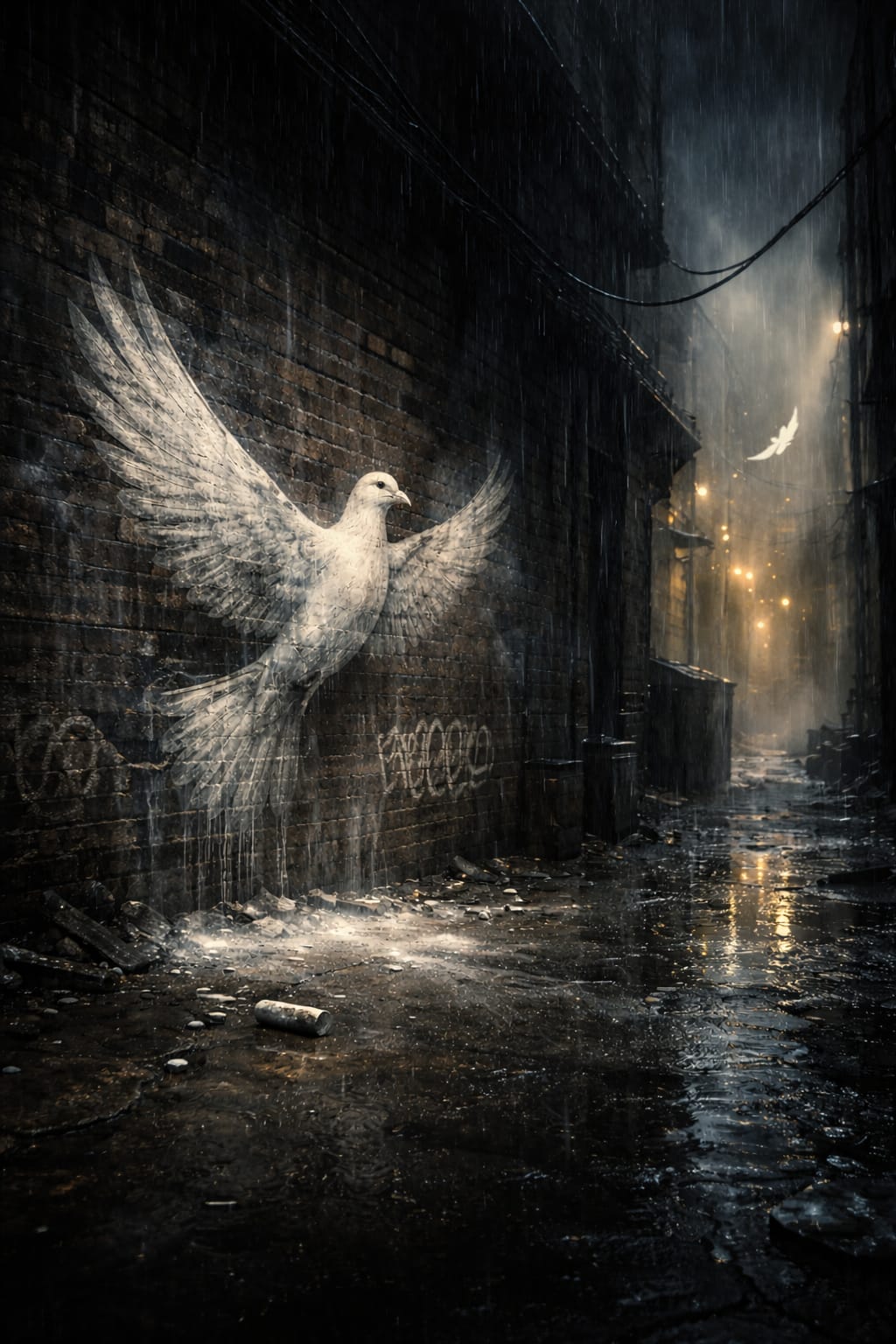
Some nights we still go out and draw birds on walls. Some are erased before morning. Some survive a day or two. Sometimes no one notices. Sometimes small children point and ask, "What's that?"
On the last night I went out, I drew a large pigeon in a narrow alley, for Selim Abi. Just as I turned to run, I swear I heard it: a wingbeat, deep and true, only for an instant. I sank to the curb and cried.
—deri