MOTHER
by deri••365 views
MOTHER
She checked how much money was in her wallet. “Forty-three lira, fifty kuruş. Maybe I can buy a bit of fruit. She doesn’t eat properly. At least let her eat fruit; she’s starting to look like a corpse,” she thought. As the ferries blasted their first whistles, she set off. She had nothing else to do; she had to go to her. And if she didn’t go… God forbid, she really would die.
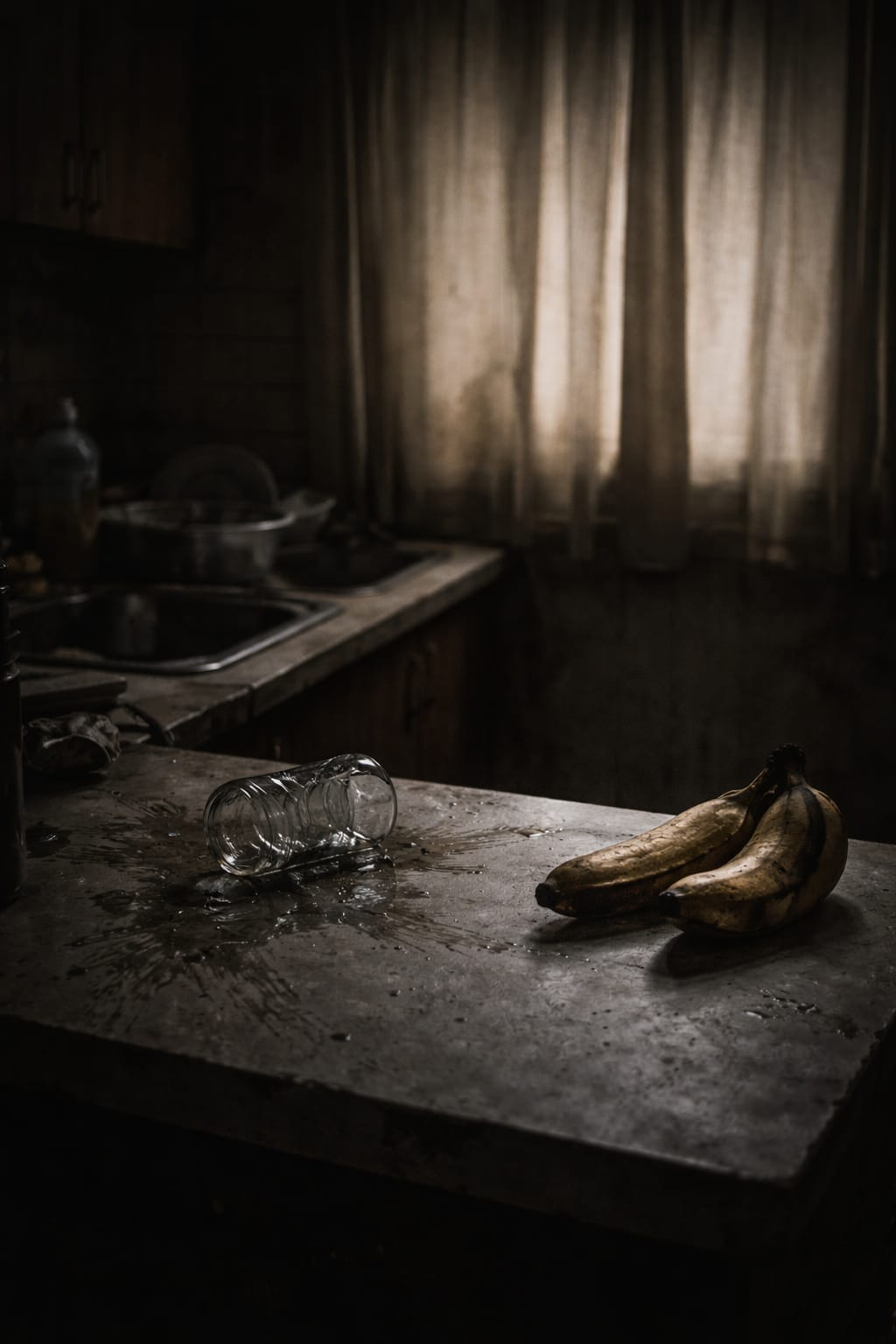
Her money was enough for half a kilo of apples and two bananas. So be it. Her daughter loved bananas.
Every time she saw a banana, the same vein in her nose would ache. The fragrant, impossibly expensive, unreachable fruit of her childhood. In the neighborhood where she grew up, she would sometimes see it in other children’s hands and her insides would twist with longing. Now she could buy it, at least a little. How strange. She had first tasted one at nine. With the weekly wage from the textile workshop, without telling anyone at home, she set aside a little for herself, bought a single banana from the greengrocer, and never forgot the taste. Later she ate bananas again, but she never tasted anything like the one she’d eaten hiding in a narrow alley.
As she did every day, she dragged her brown shoes, worn down by walking, the kind she still couldn’t manage to replace, up the long hill that led to her daughter’s place. Her head was always lowered; she never met anyone’s eyes.
Because she knew her daughter hated opening the door, she would take her key out as soon as she reached the top of the stairs. Sometimes she ran into neighbors in the building, but she would slip inside without speaking, without answering even if they called out. This strange woman always left the neighbors staring after her.
She slid her slippers onto her small feet, set what she’d bought down by the door, and, hiding the tenderness in her soul, called out, “I’m here.”
She always found her daughter in the same place: in bed. A woman who couldn’t go outside didn’t have much else to do. Aside from keeping her up with the lessons she herself taught her, and spending time with her.
Whenever her mother came, the woman would rise silently from her bed, go to the living room, sit behind her little girl who was watching television, and breathe in her hair, stroke it. Then she would begin telling her stories. And after that came playtime. Hide-and-seek. In the tiny apartment, one of them would hide, the other would search. Those were among the rare moments the woman smiled.
The woman’s love for her daughter always affected the mother deeply, pulling her back into her own childhood: the filthy-haired child no one on the street wanted to claim. A child who had never really been a child. She would sit quietly in a corner and wait for the moment to end.
The woman turned to her daughter and said, “Go on, play by yourself for a bit.” She watched her until she left the room, then turned back to her mother. “Welcome.”
The relationship between the mother and the woman was, unlike the relationship between the woman and her daughter, like a duty. The mother fulfilled her obligations toward the woman; the woman endured her. Between them there was an invisible wall. Any time they reached for affection, they crashed into it.
Life, really, is the sum of terrible delusions. They were drowning inside their own delusions and abstract fears.
“Did you eat?”
“I didn’t feel like it.”
“You’ll be hungry.”
“I said I didn’t feel like it.”
“Open the windows, let some air in.”
“Mom! Don’t you know I can’t stand looking out at the street? Your interference is suffocating me now. Eat, air out the house, open the curtains. Ugh!”
“Stop talking.”
And again the mother’s cold concern replaced the deep silence that followed.
“I brought fruit. Eat.”
“Bananas again?”
“Yes. And some apples.”
The woman went on in a mocking tone.
“Did your nose ache while you were buying them?”
In an instant the mother’s eyes clouded over. She was hurt by that indifferent, sarcastic attitude. The woman kept speaking, merciless.
“Now you’ll launch into your ‘we grew up on the streets, we worked in textiles’ melodrama. I can’t stand you, Mom. Let me go check on the girl.”
The mother sighed and whispered:
“Go on then.”
“Go on then.”
Everything had begun when the mother was only ten, in a shantytown neighborhood. Up to that night, she hadn’t been a particularly loved child. But after that night…
It was around two in the morning when the pounding on their door threw them out of bed. She was an only child. As her father moved toward the door, he warned sharply:
“Woman! Take the child and stand back!”
When he opened the door, the crowd outside poured into the house at once, seized him, and flung him into the middle of the street. Her mother screamed, “What’s happening?” but no one listened. Remembering the beatings she’d taken from her husband, she fell silent and waited in a corner. The child, who had never received love from her father, watched the lynching with an ice-cold face. Kicks, punches, curses flew through the air; her father was thrown around like a rag doll. To understand why, it was enough to listen to what they were shouting.
“You bastard! That girl’s eight. She could be your child, and you…”
Thud. A fist to his face.
“Shameless lowlife! I’ll kill you. How can you do that to a little girl?”
Bam. A kick to his stomach.
Curses…
Her father didn’t say once, not once, “I’m innocent.” He didn’t say, “Stop.” What had happened was clear, but his attitude was impossible to grasp. What turned the child’s world into hell was this: for a moment, just a brief moment, she saw a damned smile beside her father’s bloodied lips. Her mother bent down and whispered in her ear, “Look and see.”
The end of the world…
The gendarmerie didn’t arrive in time. Her father died right there. Immediately afterward, her mother left the house while the child slept. She waited for hours at home, hungry, for her mother to return. When she didn’t, she knocked on a neighbor’s door. The neighbor drove her away as if a monster stood there and slammed the door in her face. Then the whole neighborhood declared her the monster’s daughter. She drifted from place to place until an old neighbor, nearing her eighties, the one everyone called Grandma, took her by the hand and left her at an orphanage. After that…
Catastrophe…
The mother came back to herself, wiping away the tears on her face. She turned to the woman.
“How long is this going to go on like this?”
“Mom! I can’t go out. I can’t. I can’t go out into the street!”
“Fine, don’t. My effort isn’t enough for you. You’re ungrateful, that’s what you are.”
“And you’re ignorant.”
The mother’s neck sagged further; she swallowed whatever she wanted to say. The woman continued.
“Stop hovering over me. You’re choking me.”
“I only want what’s best for you.”
“Don’t… Instead of caring about me, care about your grandchild. Have you ever loved her even once, Mom?”
“I…”
“Have you, Mom?”
“I…”
“Should I tell you something? You were never a good mother, and you’re not a good grandmother either. You think bringing food, buying fruit, is motherhood. But it doesn’t work like that.”
Even so, the mother gathered herself. She stood up and for the first time took her daughter’s hands in her palms. Her head was bowed, her face collapsed inward. If she could, she would even have hugged her.
“We need to talk. Sit down, if you want. Look, I don’t know how to say this, but I have to. I’m going to say it.”
“What are you talking about, Mom?”
“I have to tell you.”
“Mom, say it already. Don’t drag it out.”
“You have to stay calm.”
“Mom, stop. I’m bored. Say whatever you’re going to say.”
“…Which grandchild, my girl?”
“What do you mean which grandchild? How many grandchildren do you have?”
The mother swallowed, and in a voice like a moan:
“My girl… I don’t have any grandchildren.”
The woman rolled her eyes at her. With a ridiculous, mocking smile:
“You’ve really lost it. Shouldn’t you go see a doctor, Mom?”
“The girl…”
“Enough!”
“What girl? Do you hear yourself? My daughter, my daughter doesn’t exist, is that it? Mom, you never loved her even once. You never stroked her hair. You turned your head away, you didn’t even look at her face, fine. But this is too much. Get out. Leave us alone.”
“Do you remember the day she was born?”
“What do you mean now, that… that thing… It happened, you know…”
“What happened while she was growing up to this age?”
“Mom, this has gone on too long. Go now.”
“When was the last time you fed her? Has she ever gotten sick? Has she ever fallen and scraped her knee? Does she have any scars? Has she grown?”
…
“My girl?”
…
After a long silence the mother was in ruins. She was exhausted from trying to convince her daughter. The woman spoke slowly, calmly, each word measured.
“So that’s why she never got sick… Mom…”
They both sank into a deep silence. Tears streamed from both of their eyes. The woman’s shoulders slumped, her gaze turned glassy, her head dropped as she walked toward the kitchen. The mother watched her. The woman’s hands rested on the counter for a while. Without speaking, without even breathing. Then she turned to her mother.
“Mom?”
The mother looked at her daughter as if to say, Yes?
“Do you remember how I grew up?”
She struck the glass on the counter against the shelf and shattered it. With the shards in her hand, she pressed them to her throat and cut her own neck. Not the slightest expression of pain crossed her face. Only in her eyes did a brief flame of vengeance flare and go out. The left side of her lip twitched, and she collapsed to the floor in blood.
The mother watched, frozen. For a while she stared at her daughter. She didn’t even realize the tears on her own face. She shook her head slowly from side to side, unable to believe any of it could be real. Then her scream echoed through the apartment. Her wail filled the whole building. She ran and shook her daughter, trying to bring her back. When she collapsed to the floor, she could hear the neighbors’ voices at the door, pounding.
“Open up!”
“What’s going on in there?”
“The sound came from here!”
“Open the door!”
“We’ll break it!”
Outside, they threw themselves against the door, trying to smash it. The building had turned into a scene from Judgment Day.
The mother couldn’t even hear her own voice. Words simply fell from her lips: “I caused this, I caused this, I caused this. I shouldn’t have said it.” She laid her daughter across her knees, stroked her hair, and as she cried and wailed she blamed herself for not taking her sick daughter to a doctor.
When they finally managed to break the door down, the moment it opened they couldn’t stop themselves from retching. The place stank like death, the smell unbearable. Rotting food was scattered everywhere, crawling with maggots, spoiled, decayed. They looked at one another, trying to make sense of it. The mother was kneeling, as if she were stroking something imaginary in her lap, and sobbing wildly. Inside there was not a single piece of furniture, not a single condition fit for living. In the house there was only the mother.
And the flies.
Meltem AVCI