THE FALL
by deri••281 views
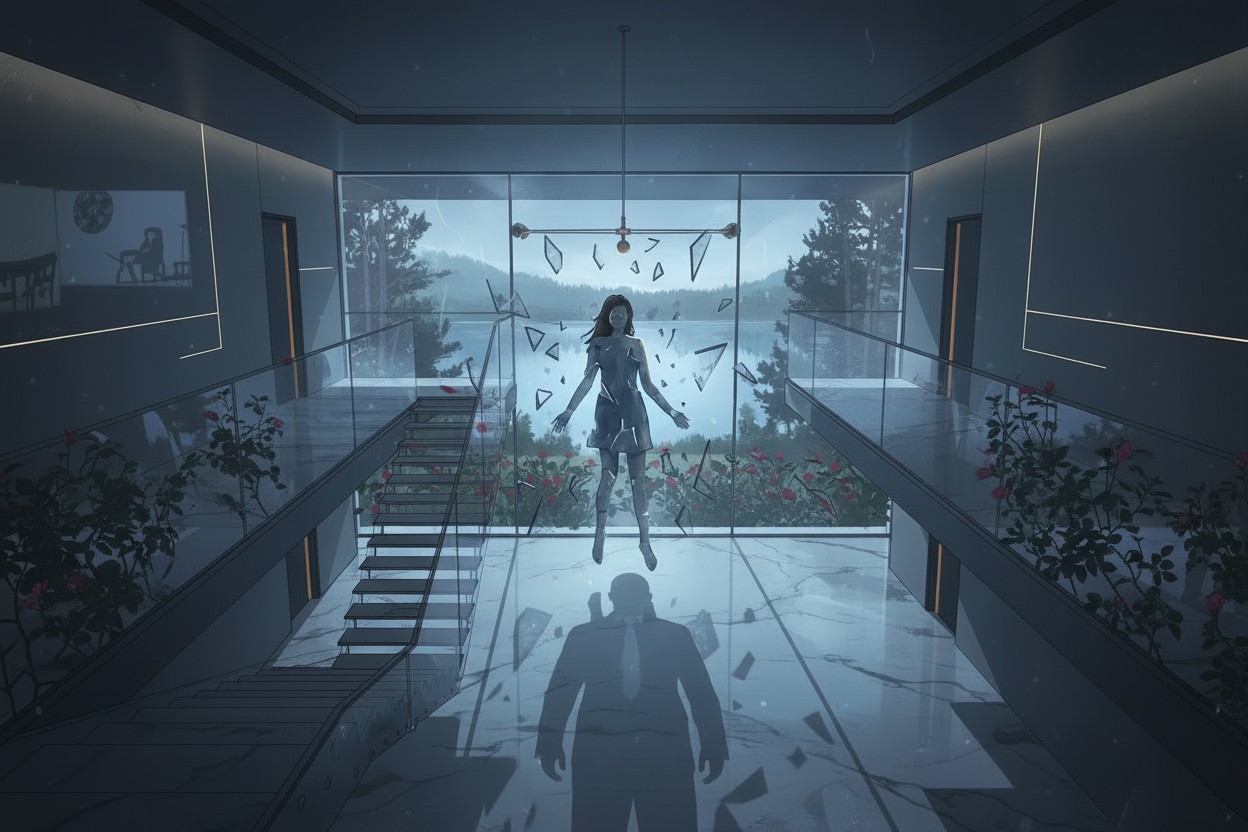
THE FALL
I fell. I blacked out.
When I opened my eyes in the hospital’s intensive care unit, my past was a sealed room with the lights off. Everything was gone. Even my name.
They said I’d struck my head on the way down. Head trauma. My memory might return, or it might never return at all. I would have to live inside that uncertainty and do “memory exercises,” anything that could coax my past back to the surface.
As they were explaining all this, he walked in.
A large bouquet in his hands. A wide smile on his face.
“So you’re awake,” he said. “It’s wonderful to see your eyes again.”
Handsome. Charismatic. Impeccably dressed. The kind of man who looked like he belonged in rooms where people lowered their voices.
He was my husband.
He hadn’t left the hospital for a minute. According to the doctors, I’d been there for exactly twenty-two days: one broken arm, a leg fractured in three places, moderate injuries to my face and ears, and the head trauma that had emptied me out.
When I asked what happened, the gentleman began to narrate my life back to me.
“I came home from work and called out, ‘I’m home!’ You’d set a beautiful table on the rooftop to surprise me. You ran toward me, your ankle twisted on the stairs, and you started to fall. I ran to catch you, but I was too late. We brought you straight here. I was terrified you’d… I can’t even tell you how scared I was.”
He spoke with such conviction, such practiced tenderness, that I almost believed my own absence was a misunderstanding.
Almost.
His story should have meant something. It should have sparked a feeling, a flash, a familiar warmth. But it fell into me like stones into an empty well. I could see, from the way my body didn’t recoil, that I must have loved him once.
Yet the love was gone, leaving only the outline.
The next day, the paperwork was finished. He drove me home, and I understood what “enormous” really meant.
We lived in a villa on a vast estate, land stretching out as if it had been bought to keep the world away. Before I arrived, he’d had the house prepared, cut the staff in half, and taken my care entirely into his own hands. He would bring me down to the garden to rest while my room was cleaned.
“For now, you shouldn’t see anyone,” he said. “First, I’ll do everything to help you remember me.”
And, to my own surprise, that was what I wanted most.
He painted our marriage in colors so beautiful that forgetting it felt like vandalism.
He said I loved fishing in the lake behind the house. That I would climb trees and eat fruit straight from the branches. Childish things, he called them, smiling, as if that childishness had been a private language between us.
I smiled back, aching for a memory that refused to show itself.
Days passed. Even if I couldn’t remember the man I called my husband, his attention, his carefulness, his constant presence kept feeding a small, stubborn hope.
My arm healed. My leg healed. My bruises faded.
I began to want the outside world again.
“Did I have friends?” I asked one day.
He hesitated only a fraction. “Not many. You didn’t like going out.”
“And my parents?”
“You don’t have any,” he said, gently. “They’re gone.”
It hit me like a second fall. Grief without a face, loss without names. I cried the first time I heard it, then learned to live with that blank space too.
He took my hand. “We were everything to each other,” he said. “Husband and wife. Best friends.”
If we were enough for each other, why not?
So we made a small world inside a large house. We played cards. We fished. We climbed trees. I laughed like a child, light-headed with the strange perfection of it.
Everything was almost perfect.
Until the day I asked, “What about your parents?”
His face tightened so sharply I thought, for a heartbeat, he might snap in half. Then his expression collapsed into something old and heavy.
“They’re dead,” he said, voice low.
And he changed the subject.
That was when I understood: there was a wound in him that didn’t want air.
I didn’t press. Not then. But curiosity is a kind of hunger, and mine began to gnaw at me.
To make him happy, I started cooking again. He went to the factory during the day and returned to the meals I made, to conversation, to evenings spent looking at photographs.
I wasn’t photogenic. In every picture my eyes carried a shadow. Apparently, I hated being photographed. Strangely, even now, I didn’t feel the urge to see myself frozen on paper.
I also learned a herbal tea recipe. It seemed to calm him. Every evening I brewed a cup and watched him drink it with quiet pleasure.
One night, while he was sipping, I tried again.
“Darling… do you want to talk about your parents?”
Silence.
Then, a faint, almost childish refusal. “No.”
“I want to know everything about you,” I said. “Every detail. Please.”
“I told you. They’re dead.”
“I know. But… how?”
“A car accident.” His gaze moved past me. “I was eight. We were wealthy. There was no shortage of people to take care of me. But they were gone.”
“You were so young.”
“The tea is wonderful,” he said, too brightly. “Thank you.”
He sealed the subject shut again. I didn’t ask after that.
That night, he tossed and turned as if the bed had become a place of punishment. I fell asleep before he did, but he must have drifted off at some point, because he jolted awake screaming:
“Mom!”
I shot upright. He was drenched in sweat, eyes wet, the muscles in his jaw locked hard.
When he realized it had been a dream, he didn’t relax.
He stiffened.
He got out of bed and left the room.
I said nothing. I let him go. And somewhere in me, shameful and small, something like satisfaction unfurled.
In the days that followed, he became someone else.
Quiet. Withdrawn. Irritable, as if his skin was too tight for him.
Every night, the same scream, the same word ripped out of sleep: “Mom!”
It began to frighten me. All I could do was add a little more root to the tea and hope, absurdly, that comfort could be brewed.
As time went on, some nights he didn’t come to bed at all. When I went downstairs, he would be awake, eyes wide, fighting sleep like an enemy.
I would hand him the tea and return to bed, helpless. I tried to tell myself it was temporary. A phase. A storm.
Then he stopped eating.
I couldn’t bear it.
“Love,” I said one evening, “do you want to talk?”
“No.”
The word was so sharp my knees trembled. It sank into me like a fear I couldn’t place.
“All right,” I whispered.
I turned toward the kitchen, and then I heard him.
He was talking to himself, voice low, broken into pieces.
“I couldn’t, Mom. I was eight… How could I have been strong enough? It wasn’t my fault, don’t say that… Please… Don’t call me that… Dad had decided. I couldn’t stop him… Mom, I didn’t kill you… Forgive me… Please…”
Sometimes he screamed as if someone stood in front of him. Sometimes he sobbed. Sometimes he laughed in a way that turned my stomach cold.
I was afraid. And I pitied him. Pity arrived like an unwanted guest and refused to leave.
I forced him to eat. It didn’t work.
I begged him to see a doctor. He refused.
“Maybe work will help,” I suggested. “Maybe it’ll distract you.”
He hesitated. “Maybe.”
After that, he began going to the factory again. It did seem to take the edge off, just enough. He slept a little. He ate a little. Not living, exactly, but not dying either.
The monologues didn’t stop. They evolved.
He began reacting as if something had suddenly appeared in his path, stopping mid-step to avoid a collision with thin air, then continuing to argue with the empty space.
“I didn’t do it… Don’t be angry, Mom… Don’t cry…”
Weeks passed like this.
Then one afternoon, the phone rang.
A police officer. Calm voice. Official words.
My husband had been in a car accident. He’d been taken to the hospital. I needed to come.
I went.
And I learned he’d died at the scene.
They told me he’d suddenly swerved into the median, crossed into oncoming traffic, and collided with a truck. The doctor spoke softly.
“We think it was a heart attack.”
I cried. I played my part. I returned home and instructed the staff to begin the funeral arrangements. The burial was crowded, heavy with voices and condolences.
People said tragedy had a special talent for finding us.
Some offered sympathy. Others offered expectations: be strong, be brave, endure.
It all sounded rehearsed. None of it touched me.
After the funeral, I returned to the villa alone.
I sent the staff away. I wanted complete silence.
When the last car disappeared down the long drive, I opened a fine bottle of champagne.
A victory deserves a toast.
Why?
Let’s go back to the stairs.
That night he’d allowed me to leave the house for the first time in a long while. As usual, we were going to one of his friends’ houses for one of those stupid parties. For me it wasn’t even a problem. A party meant a little air. A balcony. A corner where I could breathe.
Because I could only breathe when he wasn’t beside me.
When he was near, it felt as though an invisible hand tightened around my throat.
My life was a loop inside the walls of a grand villa, pacing from room to room, waiting for the moment I could finally put a period at the end of the sentence.
On the way home, he said, “I saw what you were doing,” and I had no idea what he meant.
According to him, I had been exchanging glances with a man at the party. But all I had done was try to be alone. Step out onto the balcony. Sit and let the noise pass through me.
He screamed the whole drive. Threats, insults, accusations. He said I’d married him for his money. He said he would divorce me. He said he had an army of lawyers ready to prove my “infidelity” and leave me with nothing.
As if I cared.
I had loved him once, truly. I would have married him even if he’d been homeless. But I had watched, front row and alone, how an angel can rot into a devil.
He was jealous. Possessive. Cruel. A tyrant in a tailored suit.
The fight followed us into the house. And that was the moment I chose to end it.
I left him in the living room and hurried to my dressing room. I packed a small suitcase, a handful of necessities, and headed for the door.
He caught me at the top of the stairs.
He grabbed my arm, apologized, tried to embrace me, begged, clung to my legs. When he realized I would still leave, he slapped me with all his strength.
The blow came out of nowhere. My feet slipped. I fell down the stairs.
From his later conversations, you can guess the shape of his childhood: a mother, a father, violence, grief.
But the real horror wasn’t that his father had killed his mother.
It was that he was becoming his father.
My love. My amnesia. My great compassion.
Of course it didn’t happen the way he told it.
Everything happened the way he wanted it to.
But the truth is, everything began in intensive care.
I did wake up there.
I simply woke earlier than they thought.
Two nurses were in my room, discussing another patient. It was shift change, one nurse briefing the other.
“Male, twenty-two. Took hallucinogens.”
“Chemical?”
“No. Natural. Spent the whole day swimming at a friend’s pool, took hallucinogens at night. Thought he was jumping into the pool from the balcony and jumped. Both arms, radius and ulna fractures. Risk of infection. Head trauma. Second and third-degree injuries. He’s sedated for now. Survival doesn’t look likely.”
Hallucinogens.
The young man they were talking about handed me a perfect idea, wrapped in tragedy and delivered on time.
I couldn’t even feel sorry for him. Not then.
I felt grateful.
To execute my plan, I first had to pretend I’d lost my memory. With head trauma, it would be believable. At worst, the doctors would say, “There’s no medical reason for her memory loss, it will return,” and it still wouldn’t matter. I would be the amnesiac wife. The blank slate.
They didn’t question it as much as I feared.
Then came the hardest part: research. I needed a substance that would look like a heart attack even if an autopsy was performed.
And it had to be natural.
You can already guess I found the right one.
Getting it wasn’t easy, but I managed. The reduced staff made everything simpler. The first day he had to return to the factory, a supply of roots enough to last me for months arrived at my door.
My husband’s herbal tea.
I gave him the cup again and again, always “to help him rest.”
At first, only a little.
As his body adjusted, more.
And in the end, I poured the greatest ache of his life back into his mind.
His mother.
Soon he saw her everywhere. He argued with her in empty rooms. He dissolved, slowly, into hallucination. The tea disrupted his sleep, scrambled his sense of time, loosened the bolts holding his mind together.
I waited until he could no longer tell what was real.
Then, on the morning he was meant to drive to work, I served him a cup brewed strong enough to swallow a life.
I knew he wouldn’t come home.
So what happens now?
Now the army of lawyers who were supposed to prove my “infidelity” in a divorce will instead handle the inheritance proceedings.
In my name.
As his sole heir.
deri