There Is No Promised Place
by deri••381 views
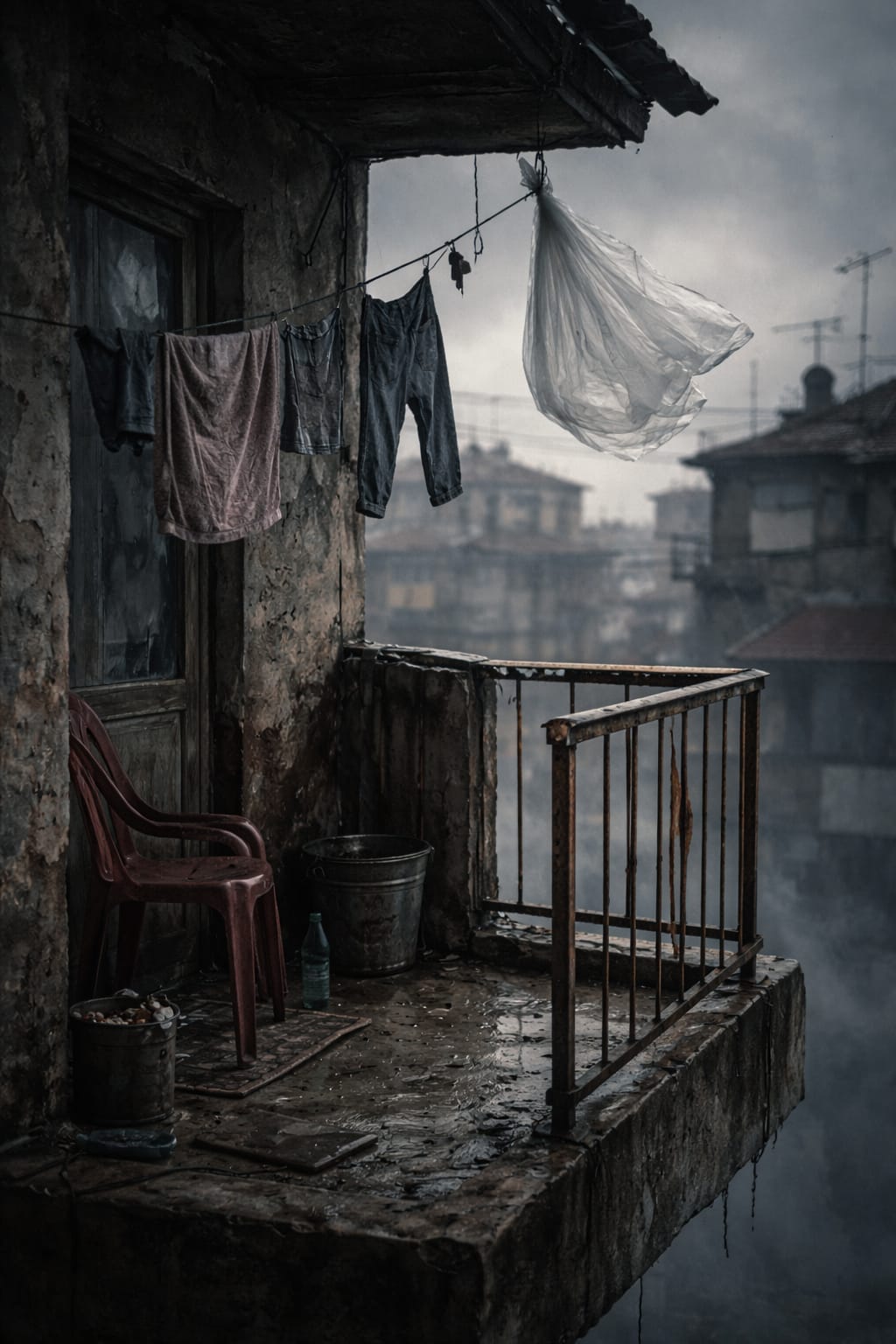
When you step into poor neighborhoods, two things catch your eye. First, the faded laundry hanging from balconies; second, the scarecrows. Not the kind you’re thinking of. Plastic bags. Bags tied to the end of a string so birds won’t land on balconies and windows. Because they foul the place, because they carry scraps to build their nests. And yet, it’s the birds that beautify these neighborhoods the most.
Around here, when you walk to the corner shop you always slip into the rubber sandals kept by the door, and more often than not a child’s sandals are a size or two too big. Because all the houses were built illegally, they’re left unplastered, their walls cracked and broken. And inside them there aren’t, as people like to imagine, poor but happy families. Because there is no money. In winter, the soot from the stove ruins their peace; in summer, the heat does. The electricity is cut, an unpaid bill does. The water is cut, the filth does. When the wood and coal run out, the cold does. These are the homes of husbands in prison, of teenagers sunk in the mire of drugs, and of children who have learned to curse. And they are the homes of women: sleepless, burdened, and most of the time on the verge of tears. Birds are too much for these houses.
It was in one of those homes that I met B. Ten, maybe eleven, with a speech impairment and an intellectual disability. He too wore sandals two sizes too big on bare feet, and it was winter. He’d squeezed himself into an old pair of shorts, and in a torn T-shirt he stood by my car. I had never felt so ashamed of wearing a coat.
He helped me brush the snow off the car. “You’ll get cold, leave it, I’ll do it. Go home,” I said, but he wouldn’t listen. His intention was obvious: he wanted a few coins for pocket money. He wanted them because he longed for chocolate and chips. He wanted them because he’d grown too big to dream. Maybe a piece of gum would remind him he was a child. But what mattered wasn’t helping B. It was B.
There were three siblings: our B, his sister D, and their older sister N. Their father was in prison; their mother worked in the fields when there was work. They lived in the basement of a two-story house with an illegal extra floor. No, no. You couldn’t call it living; they were trying to cling to life. Only a tiny window let any light in. Lack wrapped itself around everything. The school says, “Buy the books,” but there’s no money. The electricity is off, there’s no food, the mother has gone to work, and there’s no one to take the children to school. Nothing, nothing at all.
I’ll never forget it: one evening on my way home, his mother stopped me. “B is gone,” she said. “Gone? Since when?” I asked. “I last saw him this morning,” she said. Then she asked, “Should I call the police? Would it be shameful?” The moment she said that, I lost it. It was eight at night and the child was missing. I called immediately; a patrol car came. I stayed beside her because she couldn’t explain herself. We went out searching, turning the neighborhood inside out, and in the end we found him at an arcade. N slapped B so hard my heart clenched. I still couldn’t say a word. As the police walked away, his mother was dragging B into the house.
In this neighborhood, we kept running into each other on the way to the corner shop, in sandals two sizes too big and torn pajama bottoms. We became doorstep conversations, memories squeezed into a single hello. Then we forgot and went on trying to live.
I met up with B many times and we collected memories that wouldn’t be forgotten. We ate, we went out for hot instant orange drink. We talked. He ran away from that house and I caught him; we fought, we made up… I knew he loved me. I loved him too.
One night, his mother called around midnight. B had been missing since morning. He hadn’t gone to school either. On the phone she was crying like she’d gone mad: “I was at work. I’ve been searching since I got back. For God’s sake, find my son, you’ll find him.”
I got dressed and went to their place. Fear was written all over the girls’ faces, but the mother was shattered. “The police?” I asked. She had called. “He’ll come back. If he doesn’t, call in the morning,” they’d said. Of course, a child who runs away often, especially a child who is almost parentless, didn’t deserve much attention. We decided to search for B ourselves. We found him. We couldn’t look. We went mad. His mother collapsed and fainted. Somehow I called the police. I don’t remember the rest.
Two boys addicted to drugs had stabbed him, and he’d died right there. He had ten lira on him; they wanted it. B resisted, refusing to hand it over. That’s what the police told us later. In his bloody palm he was clutching the money that might have reminded him he was a child, and he didn’t let go.
This is a poor neighborhood. People hang scarecrows so their balconies and windows won’t get dirty. Birds are too much for this place.